At low tide, Ada found a brass key behind the archive's oldest ledger. The paper tag on its handle read NORTH.
A story
never ahead
of you.
A companion for the details you love, and the chapters you haven't reached yet.
Between the Lines is a local-first web application for books and television. It organizes people, events and relationships around one simple promise: evidence from where you've stopped, not from where the story ends.
↳ The last chapter is yours to choose.
Fig. 01 STORIES IN PROGRESS
01THE PREMISE
THE PROBLEM
You shouldn't need to risk a spoiler to remember a name.
Ordinary search treats every chapter as fair game. Readers do not. A character's significance can change, a relationship can turn, and even a harmless summary can ruin a reveal.
This project began with a different unit of information: the last completed chapter or episode. Everything downstream—the shelf, character notes, evidence search and optional AI—has to respect that boundary.
“
Design principle
The software should be able to say “I don't know” and point to the page it does know.
02THE EXPERIENCE
MADE FOR READERS AND WATCHERS
More than a shelf.
A memory of the story.
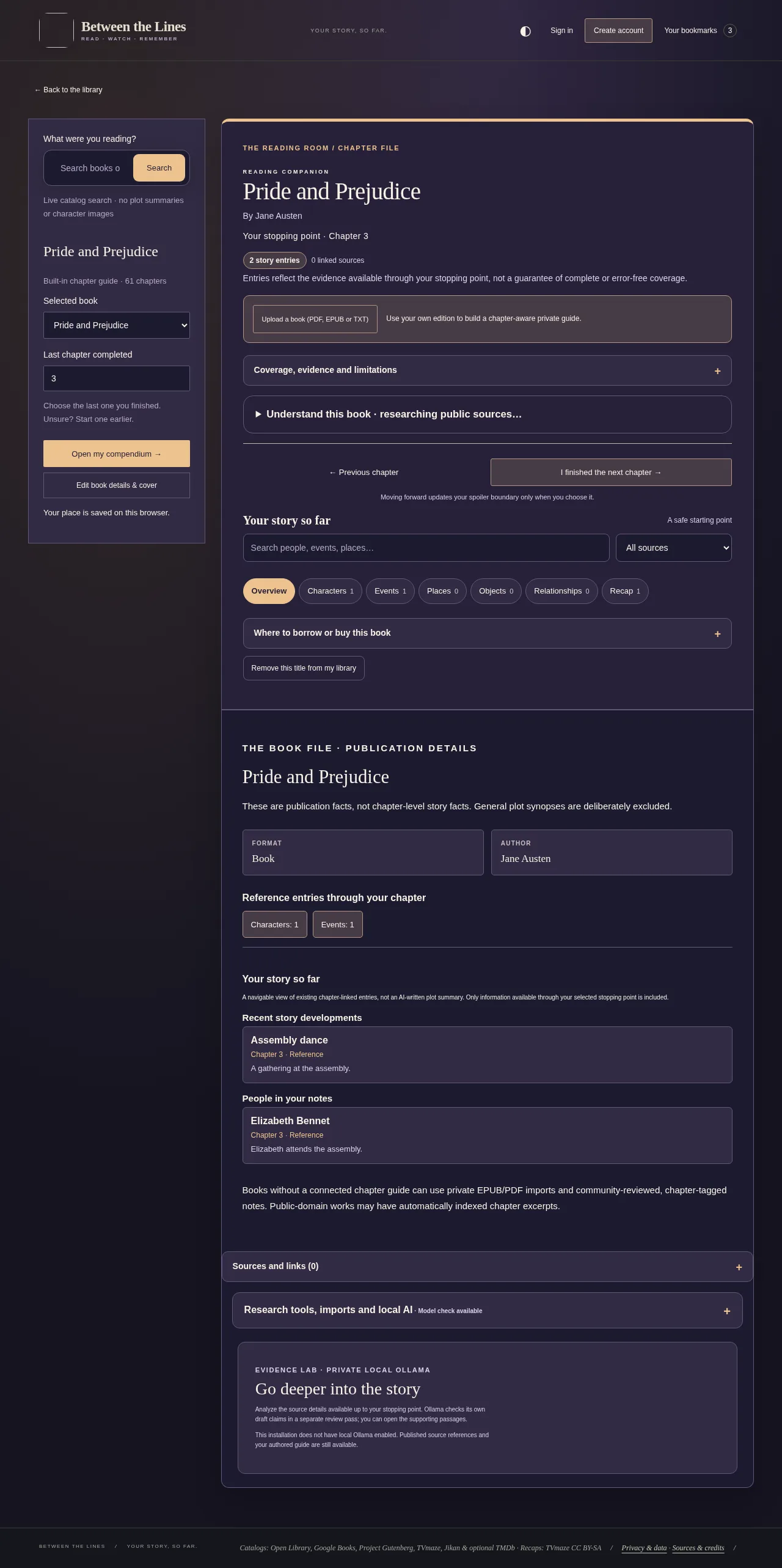
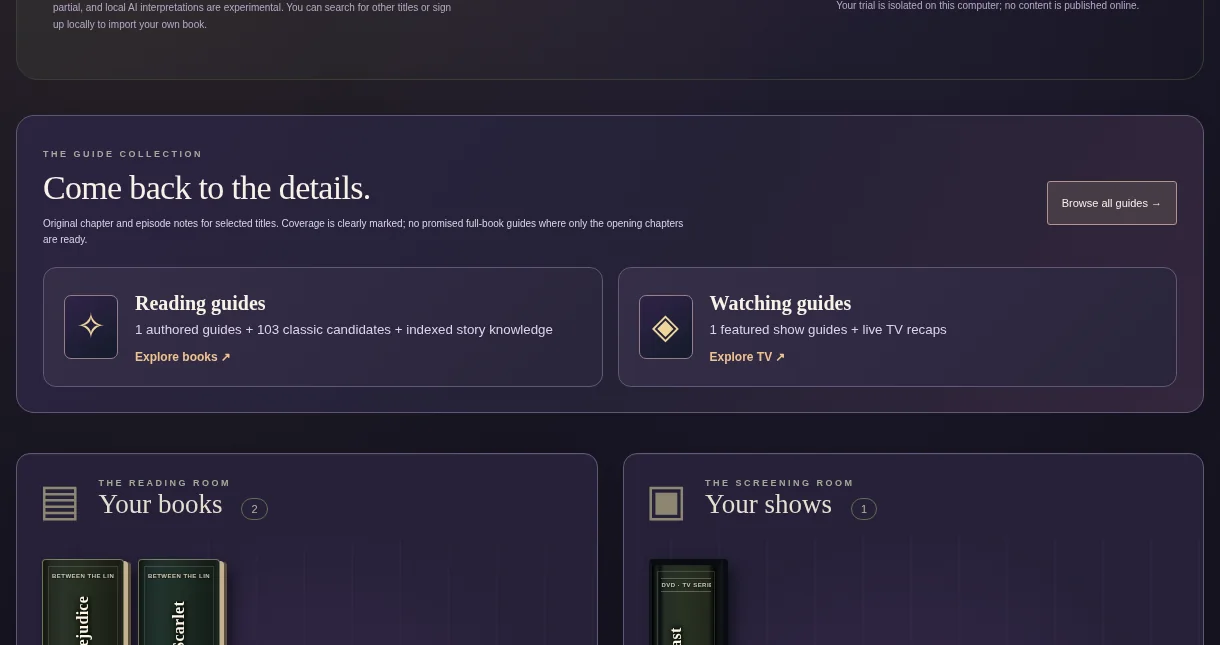
Real screenshots from an earlier development build appear below. You can also enter the public interactive demo, built with original sample stories and no account required.
01 / STOPPING POINTS
Your chapter, your boundary.
Each guide is scoped to the part of a story you've completed. Reading progress is under the reader's control.
02 / EVIDENCE TRAILS
A source, not a guess.
Characters, interactions and events carry links to passages. Uncertain relationships stay labeled as uncertain.
03 / LOCAL RESEARCH
AI with guardrails.
Optional self-hosted Ollama can analyze imported text. Its explanations are drafts, checked against available sources—not certified facts.
03THE PRINCIPLE, IN PRACTICE
INTERACTIVE DESIGN ILLUSTRATION
Turn the page.
Not the spoiler.
This short original story illustrates the reading-boundary interaction. It's a deliberately authored example, not a live AI analysis or the full application.
FROM THE FICTIONAL CASE FILE
The Archive at Low Tide
A three-chapter original scene for this portfolio demonstration.
ORIGINAL SOURCE EXCERPTSThrough chapter 1 of 3
What the reader has seen
Future chapters stay outside this reading view.
What do we know about the key?
Supported by the current source
Ada discovers a brass key with a tag marked NORTH. The source does not yet identify its purpose.
SOURCE / CHAPTER I
“Ada found a brass key behind the archive's oldest ledger.”
Still unresolvedWho left the key there? The text hasn't told us.
Only chapter I is visible.
All sample text is original fiction created for this design illustration. No account, upload, AI model or external API is involved.
04UNDER THE COVER
THE ENGINEERING
A small app in the browser.
A serious problem behind it.
The project combines a browser interface, source-aware indexing, private user storage and an optional local model. Its most important architectural choice is to keep citations and uncertainty visible.
01Reader interfaceBooks, shows, stopping points, and ten visual themes
02Node.js servicePrivate accounts, scope checks, imports, source retrieval
03Evidence layerPassages, character clues, relationships, provenance
OPTIONAL LOCAL MODELOllama offers draft interpretations. It does not replace the original text.
Uncertainty is a feature.
Names that may refer to the same character are flagged for review rather than merged on a guess. Family ties and direct interactions remain distinct evidence types.
Keep the story private.
Imported books and local model services stay on the owner's host. This portfolio page runs entirely in the browser and contains no imported novels or personal accounts.
Tests over tall promises.
The C110 checkpoint reported 1,041 passing automated tests. That is engineering coverage, not a claim of independently verified whole-novel comprehension.
05CURRENT CHAPTER
WHAT'S REAL, WHAT'S NEXT
An honest work
in progress.
The self-hosted application is a private development build. This site offers a browser-only interactive sample in addition to the private development application. It is not a sign-up page or an exposed AI backend.
Implemented in the local app
Private imports, book and TV shelves, reading-progress boundaries, evidence-linked notes, and ten UI themes.
Public demo available
Explore a working sample shelf, chapter progress, character trails, relationships, ten themes, and source-backed questions without signing in. Open the demo.
Still needs independent validation
Real-model literary accuracy, long-session performance and secure internet-facing deployment are not certified.